
Let’s get straight to the question.
What is a debt consolidation loan?
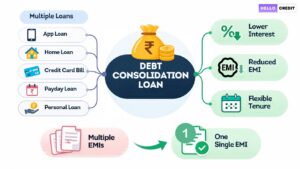
A debt consolidation loan is a financial method or strategy used to combine multiple loans, such as mobile app loans, home loans, payday loans, personal loans, credit card bills, etc., into one new loan by closing the existing loans, with the intention of reducing the amount of interest paid, lowering the monthly EMI, and providing flexible tenure options.
Benefits of Choosing Debt Consolidation
There are various benefits of a debt consolidation loan, if the applicant utilises it in the proper way it can be a good financial decision.
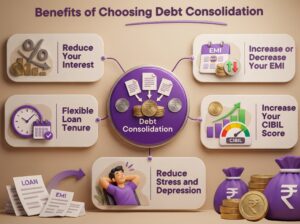
Reduce Your Interest – It helps to close loans with high interest rates such as payday loans, mobile app loans or other loans.
Increase or Decrease Your EMI – You might have more monthly expenses, or you may have lower financial commitments. In that case, getting a new debt consolidation loan helps you increase or reduce your EMI.
Flexible Loan Tenure – It helps you get the new loan amount with a loan tenure convenient for you.
May Help to Increase Your CIBIL Score – May Help Improve Your CIBIL Score – Closing old loans and repaying the new loan EMIs on time can help you maintain a good repayment history and may improve your CIBIL score over time.
Reduce Financial Stress – these are the indirect benefits you can attain, you don’t have to pay high-interest-rate loans, repeated calls from lenders, paying a convenient EMI amount is a stress-free option.
Here Is a Real-Life Example of an Applicant Who Benefited from Hello Credit
An applicant approached Hello Credit for a debt consolidation loan to close his existing high-interest loans and reduce his monthly financial burden.
Applicant Details
- Monthly Salary: ₹1,20,000
- CIBIL Score: 720
- Existing Mobile App Loan: ₹7.45 lakh at 28% per month
- Existing Personal Loan: ₹1.80 lakh at 18% per month
- Total Outstanding Loan Amount: ₹9,25,000
- Monthly Interest Payment: ₹2,41,000
- Pre-closure Charges: 4% on both loans (₹37,000)
- Total Amount Required for Loan Closure: ₹9,62,000
The applicant was paying ₹2,41,000 per month in interest alone, which created a huge financial burden.
Now, you might have a question: He is earning ₹1.2 lakh per month, but how is he paying ₹2.41 lakh in interest? The reason is that he is taking new loans to repay his existing monthly EMIs, which is known as a debt cycle.
Result
The applicant received a debt consolidation loan of ₹10 lakh at an interest rate of 16% per annum from our lending partner, HDB, with a repayment tenure of 5 years (60 months).
He used ₹9.62 lakh from the new loan amount to close his existing mobile app loan and personal loan, including the 4% pre-closure charges.
How Much Did He Save Per Month?
- Old Monthly Interest: ₹2,41,000
- New Monthly Interest (First Month): ₹13,333 (approximately)
- New Monthly EMI: ₹24,318 (approximately)
- Monthly Interest Savings (First Month): ₹2,27,667
- New Loan Repayment Tenure: 5 years (60 months)
By choosing debt consolidation, the applicant reduced his initial monthly interest burden by approximately ₹2.28 lakh and replaced his high-interest mobile app loan and personal loan with a single loan at a lower annual interest rate.
He also extended his repayment tenure to 5 years, allowing him to repay the consolidated loan through a single monthly EMI of approximately ₹24,318, making his monthly repayments more manageable.
Check Whether You Need a Debt Consolidation Loan
We have listed a few questions below. If you are saying “yes” to them, then you may consider a consolidation loan option.
- Are you paying high interest rates on your existing loans?
- Do you need to reduce your monthly EMI due to other financial commitments?
- Are you struggling to manage multiple EMIs with different repayment tenures?
- Are you borrowing money to repay your existing loans?
- Do you want to combine multiple loans into a single EMI?
- Are you struggling to manage your household expenses because of multiple loans?
- Are you looking for a consolidation loan with better repayment terms and affordable charges?
How Does Debt Consolidation Work: 5 steps
So, if you are saying yes to the above questions, here is the next step you will take and you will understand how debt consolidation actually works.
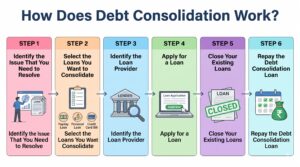
Step 1: Identify the Issue That You Need to Resolve
You might have various financial issues, such as:
- Multiple loans with higher interest rates
- Multiple loan accounts
- Trying to reduce or increase the loan tenure
- Needing flexibility in EMI payments
- Pending credit card bills
From these, identify the loan accounts you are facing issues and want to resolve through debt consolidation.
Step 2: Select the Loans You Want to Consolidate
After identifying the financial issues you want to resolve, select the loan accounts you want to close through debt consolidation.
Here is an illustrative example of consolidating loans with high interest rates.
| Loan Type | Principal Amount | Interest Rate | Pre-Closure Charge | Total Amount |
| Payday Loan | ₹1,00,000 | 25–28% per month | 4% (₹4,000) | ₹1,04,000 |
| Personal Loan | ₹5,00,000 | 18% per annum | 5% (₹25,000) | ₹5,25,000 |
| Credit Card Overdue | ₹50,000 | 30% per annum | — | ₹50,000 |
| Total | ₹6,50,000 | — | ₹29,000 | ₹6,79,000 |
In this example, the applicant has 3 existing loan accounts with a total outstanding amount of ₹6.79 lakh. The applicant can look for a debt consolidation loan with a lower interest rate and an affordable monthly EMI to close these existing loans.
Note: If you are closing your existing loans, you may have to pay applicable pre-closure charges along with the outstanding loan amount.
Step 3: Identify the Loan Provider
Once you have chosen the loan accounts you want to close, the next step is to identify the right debt consolidation loan provider.
Before choosing the loan provider, check the following:
- Are they offering a lower interest rate compared to your existing loans?
- Can they provide enough loan amount to close your existing loan accounts?
- Will the new monthly EMI be affordable based on your salary?
- Are there any additional processing fees or hidden charges?
- Can they offer a repayment tenure that suits your financial situation?
- Will the overall repayment cost be lower compared to your existing loans?
Step 4: Apply for a Loan
After identifying the loan provider, apply through the lender’s website after checking the eligibility criteria and documents required for a debt consolidation loan.
The lender may check the following:
- Monthly salary or income.
- CIBIL score and credit history.
- Existing loan accounts and outstanding amounts.
- Current EMI obligations.
- Repayment capacity.
- Employment or business details.
Based on your eligibility and the lender’s policies, the lender will decide the loan amount, interest rate, and repayment tenure.
Step 5: Close Your Existing Loans
If your debt consolidation loan is approved and the loan amount is disbursed to your account, use that amount to close your existing loans.
Let’s take the example we discussed in Step 2, where the applicant has multiple loans with a total outstanding amount of ₹6,50,000. If you receive a debt consolidation loan of ₹6,50,000 in your account, use that amount to close all the selected existing loans.
Step 6: Repay the Debt Consolidation Loan
A debt consolidation loan is also a financial obligation that you need to repay. Start repaying the loan amount without any delays to help you manage your financial stress and maintain a good repayment history. Paying your EMIs on time can also help improve your CIBIL score over time.
Mistakes to Avoid in a Debt Consolidation Loan
Debt consolidation is also a loan. Avoid the following mistakes.
Repay the Old Loans – If the debt consolidation loan amount is credited to your account, use that amount to close your old loans. Failing to do so will increase your debt burden.
Avoid Taking High-Interest Rate Loans – Don’t take a new loan with a higher interest rate than your existing loan just to extend the loan tenure or reduce your monthly EMI.
Avoid Taking a Loan for the Maximum Tenure – Choose the loan tenure based on your repayment capacity. Increasing the loan tenure may reduce your monthly EMI, but it will increase the total interest amount you pay.
Compare Offers from Multiple Lenders – Don’t go with just one lender. Compare multiple lenders and check their loan amount options, interest rates, additional charges such as pre-closure charges and processing fees, and minimum and maximum loan tenures.
Check the Pre-closure Charges as Well – While calculating the total outstanding amount of your existing loans that you want to close, include the applicable pre-closure charges as well. Many people forget to consider those charges, which may increase the total loan amount required to close their existing loans.
Don’t Apply for a Loan with a Low CIBIL Score and Overdue Payments – If you apply for a loan with a low CIBIL score and overdue payments, your application may be rejected by many commercial banks, but you can get it from NBFC for high interest rate, higher than commercial banks . Repeated loan applications can worsen your situation, as multiple hard enquiries may reduce your CIBIL score.
How to Find the Right Debt Consolidation Loan Providers
At Hello Credit, we are connected with multiple RBI-regulated NBFCs and banks. We help you connect with the right lenders and reduce the chances of loan rejection.
- Apply through our contact form and fill in the required details.
- Our team will reach out to you as soon as possible through WhatsApp or a phone call.
- We will evaluate your CIBIL report, loan eligibility, and documentation.
- Based on your eligibility and financial requirements, we will connect you with the right lenders.
Conclusion
Debt consolidation might be a good or bad financial strategy, depending on how you utilize it.Proper utilization can help you reduce your interest rate, manage multiple loans through a single EMI, and reduce your financial burden.
However, using it in the wrong way can lead to additional debt and financial stress.
Frequently Asked Questions About Debt Consolidation Loans
1. What is a debt consolidation loan?
It is a new loan taken to close multiple existing debts, such as app loans, credit card dues, and personal loans. After that, you repay only one loan with one EMI instead of several.
2. Does debt consolidation reduce my total debt?
No. It does not reduce the amount you owe. It changes how you repay it. If the new loan has a lower interest rate, you may pay less interest, and one EMI is easier to manage than many.
3. Which loans can I consolidate?
Most unsecured debts can be consolidated, such as:
- Outstanding credit card balances
- Personal loans
- Mobile app loans
- Payday loans
Whether a particular loan can be closed depends on the lender’s terms.
4. Will debt consolidation improve my CIBIL score?
It can, over time. Closing old loans and paying the new EMI on time builds a better repayment record. But applying for a loan may result in a hard inquiry, which can lower your score for a short period.
5. Can I get a debt consolidation loan with a low CIBIL score or overdue payments?
It is difficult. Many banks reject applications with a low score or overdue payments. Some NBFCs may approve the application, usually at a higher interest rate.
6. Will my EMI always go down after consolidation?
Not always. A longer tenure lowers the EMI, but you pay more interest in total. A shorter tenure raises the EMI but saves interest. Choose the tenure based on your repayment capacity.
7. Are there any charges I should check before consolidating?
Yes. Check these before you decide:
- Pre-closure charges on your existing loans
- Processing fee on the new loan
- Any other fees in the loan agreement
Add the pre-closure charges to your existing loan amount, so you know exactly how much you need to close the old loans.
8. When is debt consolidation not a good idea?
It is not a good fit if:
- The new loan has a higher interest rate than your current debts
- You are likely to take new loans again after closing the old ones
- The total repayment cost, including charges, ends up higher than what you pay now
9. How does Hello Credit help with debt consolidation?
Hello Credit is not a lender. We connect you with RBI-regulated NBFCs and banks. You fill in the contact form, our team reaches out to you through WhatsApp or a phone call, checks your CIBIL report, eligibility, and documents, and then connects you with suitable lenders. Approval, interest rate, and tenure are decided by the lender.