Check Your CIBIL Score and Report Now
Get loan approval upto ₹50,00,000
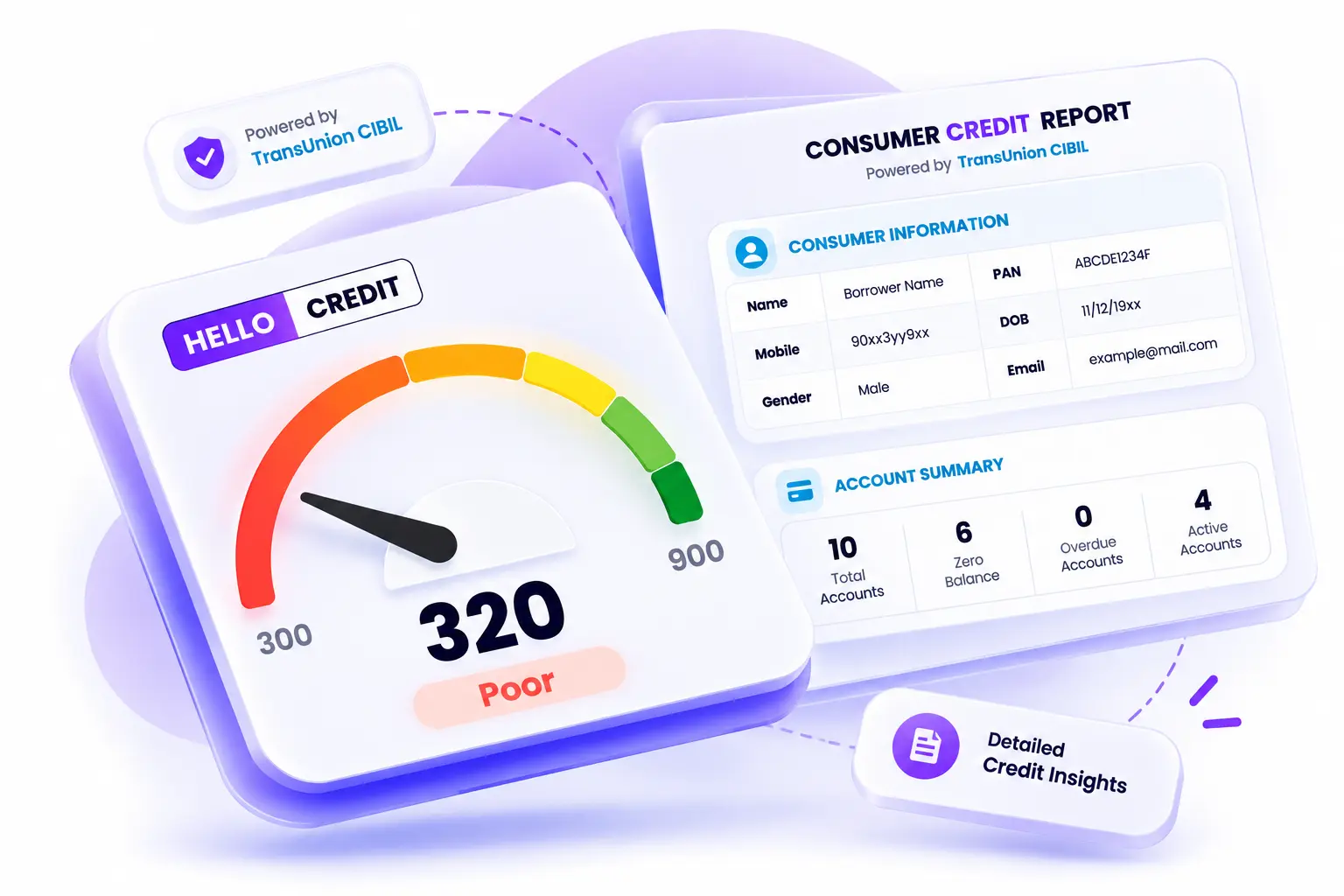
CIBIL SCORE AND REPORT
Enter your details.
CIBIL Scores from 300 to 900 and Loan Approval Chances
Many applicants check their CIBIL score when applying for a loan. Using this table, you can determine your chances of loan approval.
Loan approval chances
Low chance of loan approval
Explanation
A low score can indicate past payment issues, making approval more difficult.
Loan approval chances
Low to fair chance of loan approval
Explanation
You may qualify with some lenders, but loan terms could be less favourable.
Loan approval chances
Fair chance of loan approval
Explanation
Your score may meet some lenders’ minimum requirements, depending on their criteria.
Loan approval chances
Good chance of loan approval
Explanation
This score reflects a stronger credit profile and may improve your loan options.
Loan approval chances
Excellent chance of loan approval
Explanation
A high score can strengthen your application and may help you access competitive terms.
Loan approval chances
Qualify for a Lower Loan Amount
Explanation
It means that you do not have a credit history and may be a first-time loan applicant. Still, you will get a loan.
Keep in mind : These score ranges are general indicators. Loan amount, approvals, and interest rates depend on CIBIL or credit report, repayment capacity, employment type, debt-to-income ratio, and more, based on lenders' criteria.
Why a 750+ CIBIL Score Doesn't Guarantee Loan Approval
Check the scenario below to understand why a 750+ CIBIL score alone may not guarantee loan approval.
Person 1
750+
Person 2
750+
Person 1
₹1,00,000
Person 2
₹1,00,000
Person 1
₹35,000
Person 2
₹35,000
Person 1
More than ₹20,000
Person 2
Less than ₹20,000
Person 1
More than ₹50,000
Person 2
Less than ₹30,000
Person 1
Uses other loans to repay existing loans.
Person 2
Repays existing loans from their regular income.
Person 1
Rejected
Person 2
Approved
Why was Person 1 rejected?
Even though both Person 1 and Person 2 have the same CIBIL score, salary, and loan amount, Person 1 has higher existing EMIs and more outstanding loans. This shows that the applicant has a lower repayment capacity, making the lender less willing to approve another loan.
Why did Person 2 get the loan?
Person 2 has lower existing EMIs and fewer outstanding loans. Banks and financial institutions may therefore consider the applicant's repayment capacity sufficient to approve the loan.
Lesson
Even if your CIBIL score is 750+, you are not guaranteed to get the loan amount you want. Loan approval also depends on your repayment ability, existing EMIs, outstanding loans, and other eligibility criteria. A high credit score helps, but it does not guarantee loan approval.
What Is a CIBIL Report, and Why Do Banks and Other Lenders Use It When You Apply for a Loan?
- A CIBIL report is a PDF document that contains the applicant's credit profile and helps you know the details about your borrowing and repayment history.
- Details contained in the Hello Credit CIBIL report: Open or active loan account summary, which you won’t get in any other report, enquiry summary, employment information, consumer account details, and dues.
- This information helps banks and financial institutions assess your creditworthiness and determine your loan eligibility.
Real Example: How a CIBIL Report Revealed a Hidden Overdue
A client approached Hello Credit for a personal loan. Hello Credit is a financial marketplace that connects lenders and borrowers based on the applicant's eligibility. His CIBIL score looked decent on the surface, so he expected quick approval.
When we pulled his full CIBIL report, it showed an overdue amount of ₹18,000 on an old credit card, one he had forgotten about since he had stopped using that card years ago.
The lesson: Like us, banks don't stop at your CIBIL or credit score. They check every account, every EMI, and every overdue entry in your full report before disbursing a loan.
Choose Your Perfect Plan
Choose the plan that suits your needs. Whether you want to check your CIBIL Score and Report or need help addressing an error in your report, Hello Credit offers services to help you take the next step.
Credit Essential Plan
Get your CIBIL Score and Report, understand your credit profile, and explore loan options.
₹299
Subsequent reports for: ₹199
What you will get
- Updated CIBIL Score and Report – Access your latest credit score and report.
- Access to a Lender Network – Explore loan options from 25+ lenders.
- Expert Consultation – Get guidance on your credit and loan options.
- Loan Offers for Your Profile – Our team will support you with loan offers suited to your eligibility.
- Balance Transfer Support – Explore options to reduce your loan burden.
- CIBIL Score Management Guidance – Get tips to maintain a healthy credit score.
- Loan Consolidation Assistance – Simplify multiple loan repayments.
- Overdue Payment Assistance – Get guidance on managing overdue payments.
How to Check Your CIBIL Score and Get Your CIBIL Report?
Step 1: Select “Check Now” to get started.
Step 2: Enter your full name as per your PAN card, complete the mobile verification, and provide your personal details such as email, phone number, DOB, monthly salary, gender, and marital status.
Step 3: Enter your KYC details, including your Aadhaar number and address with PIN code. Review and confirm your information.
Step 4: Pay the required amount to get your updated CIBIL report and CIBIL score.
CIBIL Dispute Assistance
Found an error in your CIBIL Report? Get assistance with the dispute process to help address inaccurate information.
₹499per dispute
What You Get with Our Dispute Assistance Package
- Correct errors such as incorrect names, phone numbers, gender, and dates of birth (DOB).
- Help addressing accounts incorrectly marked as settled or other inaccurate loan details.
- Assistance for improving your CIBIL Score.
How to Apply for CIBIL Dispute Assistance
Step 1: Get Your CIBIL Report
Get your CIBIL report through Hello Credit and review your credit information carefully.
Step 2: Report the Issue
Share the incorrect or disputed information you found in your CIBIL report with our team.
Step 3: We’ll Raise the Dispute
Our team will submit the dispute to CIBIL on your behalf and assist you through the resolution process. The dispute resolution process may take up to 30 days.
Case study: CIBIL Dispute Resolution
Issues: An applicant was looking for a ₹5 lakh loan. While checking his CIBIL report, he found an overdue account, and he claimed that he had never received any loan amount associated with this account.
Our Assistance: We helped him to raise a dispute with CIBIL regarding the unrecognized loan account appearing on his credit report. The dispute was submitted to CIBIL for investigation, and we shared the tracking ID with our client for tracking purposes.
Resolution Timeline: The investigation and response may take up to 30 days.
Note: Dispute outcomes depend on the investigation and verification process. Raising a dispute does not guarantee that an entry will be changed or that your CIBIL Score will increase.
How Can You Improve Your CIBIL Score to Get a Loan?
Follow these steps to manage your credit score. It takes time, so be consistent.
1.Check your credit report regularly and understand why your credit score increases or decreases.
2.Pay your EMIs and other loan payments on time.
3.Keeping your credit utilisation ratio below 30% is generally better when using a credit card.
4.Avoid applying for multiple credit cards within a short period, as frequent credit applications may make you appear more dependent on credit and can affect your credit score.
5.A hard enquiry occurs when a bank or financial institution checks your credit report as part of a loan application. Multiple hard enquiries within a short period may affect your CIBIL score.
How to Improve Your CIBIL Score After Loan Settlement
After settling a loan, your credit report may show a “Settled” status instead of “Closed,” which can negatively affect your CIBIL score and future loan eligibility. You can rebuild your credit profile by correcting report errors, making timely repayments, maintaining low credit utilisation, and managing credit responsibly. Recovery takes time and depends on your existing credit history and future financial behaviour.
Direct answer: To improve your CIBIL score after loan settlement
- 1Check your credit report and dispute any inaccurate information.
- 2Use a secured credit card responsibly, if suitable for your financial situation.
- 3Pay all existing EMIs and credit card bills on time.
- 4Keep credit utilisation low, ideally below 30%.
- 5Avoid unnecessary applications for new loans or credit cards.
Consistent positive credit behaviour can help improve your score over time, although there is no guaranteed recovery timeline.
Why Does Your CIBIL Score Drop After Loan Settlement?
Your CIBIL score reflects your credit history and helps lenders assess your creditworthiness. Loan settlement may affect your score for several reasons:
“Settled” account status
When a lender accepts less than the full outstanding amount, the account may be reported as “Settled” rather than “Closed.” Lenders may view this as a sign of increased credit risk.
Missed EMI payments
Delayed or missed payments before settlement can remain in your credit history and affect your score.
Changes to your credit profile
Changes in active accounts, credit utilisation, and the length of your credit history may also influence your score.
Keep in mind: The extent of the impact varies depending on your credit profile, repayment history, and the status of other accounts. The “Settled” remark may remain on your credit report according to applicable reporting and retention practices, even as your credit profile improves.
Step-by-Step Guide to Rebuilding Your CIBIL Score
Check Your Credit Report and Correct Errors
Obtain your credit report through our website Hello Credit. Check whether the settled account, outstanding balance, payment history, and closure details are reported accurately. If you find incorrect information or duplicate entries, raise a dispute with the credit bureau and the relevant lender. Correcting genuine errors can help ensure your credit profile reflects accurate information.
Consider a Secured Credit Card
A secured credit card backed by a fixed deposit may be an option if you qualify. Use it for manageable everyday expenses and repay the full outstanding balance by the due date. Consistent, responsible use can help establish a positive payment history. Choose a card only if its fees and deposit requirements suit your budget.
Pay All EMIs and Credit Card Bills on Time
Make every scheduled payment by its due date. Even after settling a previous loan, timely repayments on your existing credit accounts are important for rebuilding your credit profile. Set up payment reminders or auto-debit to reduce the risk of missing a due date.
Keep Credit Utilisation Low
Try to use less than 30% of your total available credit limit. For example, if your credit card limit is ₹20,000, aim to keep the outstanding balance below ₹6,000. Lower utilisation can support a healthier credit profile, although it does not guarantee a particular score increase.
Avoid Unnecessary Credit Applications
Applying for several loans or credit cards within a short period can result in multiple credit enquiries and may affect how lenders assess your application. Apply selectively and compare eligibility requirements before submitting an application.
Build a Positive Credit History Gradually
Once you have established consistent repayment habits, you may consider suitable credit products based on your needs and eligibility. Do not take out a loan solely to improve your score. Borrow only when necessary and when you can comfortably manage the repayments.
How Long Does It Take to Improve Your CIBIL Score After Settlement?
There is no fixed recovery period after loan settlement. Progress depends on your previous credit history, the severity of missed payments, existing debts, and your repayment behaviour going forward.
Initial months
Review your credit report, correct any errors, and establish consistent payment habits.
Over 6–12 months
Maintaining timely payments and low credit utilisation can help build a stronger repayment record.
Over 12–24 months
Continued positive credit behaviour may support further improvement in your credit profile.
Over 24–36 months
Sustained responsible credit management may improve your overall creditworthiness, although the settled account may continue to influence lenders’ decisions.
These are general milestones, not guaranteed score-recovery periods or target scores.
Settled vs Written Off vs Closed: What Is the Difference?
What it means
The loan has been fully repaid according to the lender’s records.
Potential impact
Generally viewed more favourably than settlement.
What it means
The lender has accepted less than the full outstanding amount under an agreed settlement.
Potential impact
May negatively affect creditworthiness and future approvals.
What it means
The lender has classified an amount as a loss for accounting or reporting purposes.
Potential impact
Can be viewed negatively by future lenders.
What it means
Classification categories used in NPA reporting to indicate serious concerns about loan recovery.
Potential impact
May signal significant repayment difficulties and negatively affect how lenders assess credit history.
What it means
The loan remains active and repayments are being made.
Potential impact
Impact depends on repayment history and overall credit behaviour.
Keep in mind: The precise reporting status and its impact depend on the account history and the lender’s reporting. These terms are not interchangeable.
5 Things You Can Do Today to Improve Your Credit Profile
Download your credit report
Review your account status, outstanding balances, payment history, and personal details for errors.
Make every payment on time
Pay all existing EMIs and credit card bills by their due dates.
Keep credit card balances low
Aim to maintain credit utilisation below 30% and pay your statement balance in full whenever possible.
Dispute inaccurate information
Contact the lender and credit bureau if your report contains incorrect settlement details or outdated balances.
Avoid unnecessary borrowing
Focus on managing existing debt responsibly rather than applying for multiple new credit products.
Remember
Loan settlement can help resolve a debt during financial hardship, but it may affect your credit profile. Consistent repayment habits, accurate credit reporting, and responsible borrowing are key to rebuilding your CIBIL score over time.
Frequently Asked Questions About Personal Loans
Have doubts about rates, documents, or CIBIL requirements? Explore answers to common questions below.