
Here is the direct answer to your question
If you earn ₹60,000 a month, you can usually expect a loan of around ₹4 lakh to ₹10 lakh. This range is an approximation; lenders determine the loan amount based on several factors.
In this blog, you will get to know how lenders calculate your eligibility, real-time examples, the documents you need, and what to do if your application is rejected.
Quick Navigation
- Factors That Impact Your Personal Loan Amount
- Eligibility Criteria for a Personal Loan for a salaried person of 60k
- Documents Required for Salaried Individuals Earning ₹60,000
- Example: How Much Loan Amount Can You Get on a ₹60,000 Salary?
- How Lenders Calculate Your Eligibility
- How to Increase Your Personal Loan Eligibility Without Increasing Your Salary
- What If Your Personal Loan Application Gets Rejected?
- Personal Loan Lenders for a ₹60,000 Salary with a Low CIBIL Score
Factors That Impact Your Personal Loan Amount
Many people think salary alone decides the loan amount. It is the starting point. Here are the other factors that lenders look at as well:
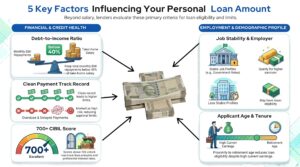
1. Debt-to-income ratio
It is the percentage of your salary spent on EMIs, loans, and other repayments. Lenders assess your loans and EMIs through your CIBIL report.
Keeping your debt-to-income ratio below 40% of your salary will help you to get the loan amount accordingly.
For example, if someone earns ₹60,000 per month as a take-home salary and the debt-to-income ratio is 40%, they are spending ₹24,000 on debt repayment, and the remaining ₹36,000 is considered to determine the loan amount. So, the amount may vary from lender to lender.
2. Overdue and delayed payments
You might have a mobile app loan, a payday loan, credit cards, personal loan EMIs, and more. Not paying these EMIs is called an overdue payment, and not paying on time is called a delayed payment.
Having overdues and delayed payments will make lenders consider you a higher risk for lending. Due to this, the loan amount might be lower, or you may have a chance of getting rejected by commercial banks.
3. CIBIL Score
CIBIL score is the first checking point for getting a loan. If you are expecting the highest loan amount, your CIBIL score should be 700+, which says that you have a good borrowing and repayment history.
Sometimes a low CIBIL score leads to,
- Rejection of the application from commercial banks
- Higher interest rate for the loan amount
- Unable to get the requested amount
Guide for Low CIBIL score: How to get a personal loan with a low CIBIL score
4. Jobs and Experience
This is an important factor for lending; some lenders may consider work experience, job titles, the company you work for, and more. A person with a stable job, such as a government employee, can get a higher loan amount than a private employee earning the same salary of ₹60,000.
5. Applicant Age
In the above subheading, we discussed that government employees may get a higher loan amount than private employees. But if a government employee is close to retirement, they may not get the expected loan amount. So, this applies to all applicants. Before applying, check your loan eligibility.
So, this rule is not followed by every lender; each lender has its own credit assessment criteria.
Eligibility Criteria for a Personal Loan for a salaried person of 60k
Eligibility may vary from lender to lender; check the respective lenders before applying
- Age: Employees aged between 21 and 60 years.
- Income: A minimum monthly salary of ₹15,000 for both men and women.
- CIBIL Score: Having a CIBIL score of 700+ is good, but you can still get a loan with a low CIBIL score.
- Credit History: Having a consistent record of on-time repayments will improve your chances of getting loan approval.
Documents Required for Salaried Individuals Earning ₹60,000
The list varies by lender, but salaried applicants are usually asked for:
- PAN card and Aadhaar (for identity and address)
- Last 3 months of salary slips
- Last 3 to 6 months of bank statements showing salary credits
Our Lenders may ask for more, like Form 16 or proof of your current address. Keep scanned copies ready, and make sure the name and details match across all documents. Small mismatches cause avoidable delays.
For more about the loan, go through our personal loans for salaried employees.
Example: How Much Loan Amount Can You Get on a ₹60,000 Salary?
This is illustrative for you; however, your actual offer will depend on the lender, your profile, and the rate you are given.
Scenario 1: Clean profile, no existing loans
You have a credit score of 750 or above, a stable job, and no running loans.
In this case, you can expect a loan of roughly ₹7 lakh to ₹10 lakh. The higher end is possible only with a strong employer category and a longer repayment period.
Scenario 2: You have a ₹16,800 per month loan
So, you are spending 28% of your salary on loan repayments, and ₹43,200 remains from your monthly salary of ₹60,000. Beyond that, you will have other expenses as well. Considering this, you can expect a loan of roughly ₹3 lakh to ₹5 lakh. The higher end is possible only with a strong credit score and a stable employer. Many applicants in this situation are offered closer to ₹3 lakh.
Scenario 3: Average credit score or high credit card usage
If your score is in the 650 to 700 range, or your cards are close to their limit, lenders get cautious. You may be offered around ₹2 lakh to ₹3 lakh, often at a higher interest rate. Some lenders may decline.
Scenario 4: Having a mobile app loan and personal loan repayments of 35% of your monthly salary
For example, a person earning ₹ 60,000 who pays ₹12,000 towards a mobile app loan and ₹9,000 towards a personal loan has total monthly debt repayments of ₹21,000. This means the debt-to-income ratio is 35%, and ₹39,000 remains from the monthly salary.
So, the person can get up to 3-5 lakhs.
This is just an example; you can get a higher or lower loan amount as well. Lenders will consider multiple factors, and based on your credit history and repayment capacity, you will get a loan.
How Lenders Calculate Your Eligibility
Most lenders do not simply multiply your salary by a number. They check how much EMI you can comfortably pay every month, and then work backwards to the loan amount.
The key term here is FOIR (Fixed Obligation to Income Ratio). It tells the lender what share of your monthly income already goes to fixed payments. Many lenders keep this at around 30% to 40% of your net income, though the exact limit varies by lender and by profile.
Some lenders also use a rough income multiple as a quick check. It is only a first filter, and the FOIR calculation usually decides the final number.
How to Increase Your Personal Loan Eligibility Without Increasing Your Salary
You do not need a raise to improve your chances. These steps help:
- Clear or reduce existing EMIs – Closing even one small loan raises the amount you can borrow or get.
- Pay down credit card balances – High utilisation hurts your CIBIL or credit score. Keeping usage well below your limit helps you avail additional finance.
- Check your credit report – Look for wrong entries or old accounts shown as unpaid, If so get the non-objective certificate(NOC) from the lender which shows unpaid, for wrong entries go reach out CIBIL dispute assistance to resolve the issue.
- Choose a longer tenure – This lowers the EMI and raises the eligible amount. Keep in mind that you will pay more interest overall.
- Add a co-applicant with income – Some lenders allow this for personal loans, so check before you apply.
- Avoid applying to many lenders at once – Each application can lead to a hard enquiry, which may reduce your CIBIL score. Lenders may also consider you a high-risk applicant if you apply to multiple lenders within a short period, and sometimes this can lead to higher interest rates.
What If Your Personal Loan Application Gets Rejected?
Don’t panic, and don’t apply again the next day. Here is what to do:
- Find the reasons for rejection: is it because of a low credit score, high existing EMIs, unstable income, incomplete documents, or an employer the lender does not accept?
- Check your credit report for any errors or incorrect entries, because the loan provider may consider you to have an overdue payment.
- And then, fix the actual problem before you reapply. This could mean paying down dues, waiting for a few months to build a better repayment record, or asking for a smaller amount.
- Eligibility rules are not the same for every lender. Before applying, check the lender’s eligibility criteria to avoid rejection. For example, some banks may not provide loans to applicants with a low CIBIL score, so try applying through an NBFC or a financial marketplace.
One thing to keep in mind is that repeated applications in a short time can lower your score further. It is better to apply once, with the right lender and the right amount.
Personal Loan Lenders for a ₹60,000 Salary with a Low CIBIL Score
A CIBIL score below 700 is generally considered low, and getting a loan from commercial banks such as IDFC, SBI, HDFC, and others may be difficult.
Here are some Hello Credit RBI-registered lending providers that offer loans, especially to applicants with low CIBIL scores.
| CIBIL score | Provider | Loan amount |
| 680 | Smart Coin | ₹1,000 – ₹5,00,000 |
| 680 | Protium | ₹2,00,000 – ₹50,00,000 |
| 650 | CreditLab | ₹6,000 – ₹1,00,000 |
| 650 | Zype | ₹5,000 – ₹2,00,000 |
| 650 | JusPay (DSA) | ₹10,000 – ₹5,00,000 |
| 650 | PayMe | ₹500 – ₹5,00,000* |
| 650 | Emergency Paisa | ₹10,000 – ₹1,00,000 |
| 650 | My Money Bazaar India Private Limited | ₹5,000 – ₹30,000 |
| 650 | BuddyLoan (DSA) | ₹10,000 – ₹15,00,000 |
| 650 | BASIC (DSA) | ₹50,000 – ₹50,00,000 |
| 650 | Utkarsh | ₹5,00,000 – ₹5,00,00,000 |
| 650 | Muthoot Fincorp (Property) | ₹1,00,000 – ₹10,00,00,000 |
| 650 | Home First Connect | ₹5,00,000 – ₹50,00,000 |
| 650 | Ram Fincorp | ₹1,000 – ₹1,00,000 |
| 650 | Creya Tech Pvt Ltd (Subhlakshmi) | ₹50,000 – ₹1,00,00,000 |
| 650 | InCred Financial Services Limited | ₹50,000 – ₹15,00,000 |
| 650 | FatakPay | ₹10,000 – ₹5,00,000 |
| 600 | TrustPaisa | ₹2,500 – ₹45,000 |
| 600 | CreditSea | ₹5,000 – ₹30,000 |
| 600 | Pocket Mitra | ₹1,000 – ₹50,000 |
| 550 | Digi Credit | ₹3,000 – ₹35,000 |
| 510 | Paisa247 | ₹1,000 – ₹25,00,000 |
| 510 | mPokket | ₹1,000 – ₹15,000 |
Sorted by minimum CIBIL score from highest to lowest. *PayMe: ₹1 lakh maximum for personal loans and ₹5 lakh for MSME/SME loans.
Conclusion
On a 60,000 salary, a personal loan between 4 lakh and 10 lakh is a realistic range, and your existing EMIs, credit score, and employer will decide where you fall. Work out an EMI you can pay without stress, and borrow only what you need.
If you want to see what you may be eligible for, you can compare options on Hello Credit. Final approval, rates, and terms depend on the lender.